 Blog | Anleitung | Futterrechner | Info
EASy - indicator of protein quality
Why I consider the biological value based on whole egg / toddler / cereals / animal experiments as a parameter for the assessment of protein quality in dog food for not effective and how I would calculate instead. As an idea of a practical indicator of protein quality in dog food.
We are looking for a formula that maps the biological value of proteins for dogs in the maintenance metabolism, which can be built into a simple database query and provides reliable comparability. The thinking model I have developed determines the proportion of Essential Amino acids in the protein that can be used for protein Synthesis. I briefly call the calculated key figure EASy.
It’s EASy – also in Hannes his feed calculator.
To explain everything, I have to go further. I apologize to the Wall of Text.
Content
1. Why high-quality protein is important just for kidney-infected dogs
2. Function of protein in the body
3. Metabolism and protein synthesis
4. Protein quality in the literature
5. The „ideal protein“ for dogs
5.1. Whole egg is far away from the „ideal protein“ for dogs
5.2. Protein Design: egg-protein „upgraded“ by potato protein
5.3. The perfect protein for dogs
6. Calculate EASy
6.1. Step 1: Efficiency of the Limiting Amino Acid (LA)
6.2. Step 2: Amount of synthesizable essential amino acids (EA)
6.3. Step 3: Reference frame for relative evaluation of the synthesizable amount of amino acids (protein)
7. Practical application of the formula
7.1. Validate protein curve
7.2. Differentiate similar products (chicken, beef, seeds)
7.3. Evaluate mixtures of different protein sources
8. Critical consideration of the EASy formula
Rework Note
1. Why high-quality protein is important just for kidney-infected dogs
Hannes has cystinuria type III , an endogenous protein metabolism disorder. After that, so to speak, I was supposed to feed „Kidney or Senior Diet“. What that means, I wanted to know. Simple answer: Protein and fat in each case a maximum of 20%. The protein must be high quality and easily digestible.
OK, I can work with it: feed 60% carbohydrates. Strictly limit protein and fat.
I am not a friend of processed ready-made food and I think I can handle that with „real“ foods like potatoes, rice, pasta, various seeds and grains.
I thought so, but it’s not that easy.
Hannes has been fed with BARF so far. That is, he got to feed about 2% of his (ideal) weight of 30kg every day. Of which 80% animal sources such as muscle meat, rumen / stomach, innards, meaty bones. Another 20% fruit and vegetables. In addition, a few additives, including eggshell powder for supplementation of bone due to previous struvite-stone formation. Thus, about 50% of its regular macronutrients is protein. They are just down to 20%. I’m going to calculate, if and how the essential amino acids still work.
Jo. And there was the problem: with 420g meat and so, per day and on average, he was sufficiently supplied with all the essential amino acids, many minerals, trace elements and vitamins. If I feed now only a maximum of 200g, in the ration, the fraction of sulfur-containing amino acids methionine and cysteine is ever under certainty with the need, synonymous tryptophan is no longer necessarily covered in demand. One or the other micronutrient is missing too. In addition, the newly introduced carbohydrate-rich foods also have all the proteins in them that aggravate the problem – they are almost completely low in sulfur-containing amino acids.
The problem is:
How can I despite
the protein restriction
ensure a needs-based supply
with essential amino acids?
First, the questions about protein in general and the needs and levels in particular must be answered. Here I came across an understandable explanation of the function of protein and the metabolic processes for protein processing in animals at the AWT (Working Group on Active Ingredients in Animal Nutrition).
The next two sections are more or less completely taken from the flyer amino acids in animal nutrition of the AWT .
2. Function of protein in the body
Protein is the most important and quantitatively dominant component of all organisms and is the „prerequisite for life“ par excellence. It can not be replaced by other nutrients in the animal organism. Protein compounds are found in every cell and serve the nutrition of all cells and thus the preservation, growth and reproduction of the whole organism. However, they fulfill this function only in conjunction with energy-supplying nutrients, vitamins, trace elements and water.
Protein bodies are compounds made up of amino acids according to the modular principle. Due to their chemical structure of about 20 amino acids, they have a strict specificity, which stands for the function of each protein body:
- Enzymes: catalytic function
- Immune Body: Defense Functions
- Bone, skin and connective tissue proteins: support and protective functions
- Muscle protein: enables the animal to do physical work.
3. Metabolism and protein synthesis
In protein metabolism, protein synthesis and protein degradation (proteolysis) occur side by side. The synthesis outweighs in the growing animal, the adult animal is in equilibrium.
Since the amino acid sequence of a protein is genetically determined, all the amino acids required for its synthesis must be available in a synthesis-synchronous manner.
The absence of non-essential amino acids can be compensated by the organism within limits by self-synthesis. But lacking one of the essential amino acids, protein synthesis comes to a standstill: a lack of a single essential amino acid manifests itself as well as the lack of protein – even if there is enough protein in the diet.
![Liebig's barrel illustrating the minimum law By DooFi [Public domain], from Wikimedia Commons](https://upload.wikimedia.org/wikipedia/commons/thumb/1/1c/Minimum-Tonne.svg/263px-Minimum-Tonne.svg.png "Liebig's barrel illustrating the minimum law By DooFi [Public domain], from Wikimedia Commons") .
.
Liebig’s barrel illustrating the minimum law.
By DooFi [Public domain], from Wikimedia Commons
Beautifully illustrated with the Liebig barrel: The shortest stave limits the barrel filling just as a limiting essential amino acid stops protein synthesis:
The remaining amino acid residues (protruding staves) must be removed. The carbon skeleton is used for energy and the released ammonia must be »detoxified« and removed from the body. This is done through the synthesis of urea and represents a very energy-consuming and kidney-stressing process. For the healthy dog this is usually not a problem.
4. Protein quality in the literature
Protein is the more valuable, the closer the amino acids are to the need and the more that can be used by the body for protein synthesis. To refer to the above picture: The less „surpluses“ must be elaborately converted and dismantled (and thus burden the kidneys), the higher the value.

Mostly the protein is classified by biological value. It tells you how much of the ingested protein is utilized by the body . It is determined by animal experiments. The reference values are measured on „whole egg“ as „ideal protein“. As an overall concept, it may or may not apply to humans. As a rough guideline, it is OK – as a specific feeding note for Hannes is not sufficient, because concrete values in different tables are often contradictory and just as often do not contain the food that I just want to feed.
Also strength athletes are known to deal with proteins and amino acids. Like the feed industry, they are accustomed to looking at amino acids like a pile of Lego bricks and using them as a kit. Strength athletes also use a biological value and do not refer to whole egg, but to the needs of preschool children (because of [muscle] growth) and calculate the value according to Oeser as EAA = Essential Amino Acid Index
An actually practicable solution, since it does not require animal experiments and only needs to be fed with data. Contentwise, however, it has the disadvantage that actually only a medium requirement is calculated – losses over the limiting amino acid are leveled, as long as it is present.
This, of course, gives me the idea to use as a reference protein from the widely agreed recommendations of NRC , FEDIAF and Meyer-Zentek instead of full-egg or preschool children as a basis.
The WHO has believed since 1993 that the best measure of protein value is Protein Digestibility-Corrected Amino Acid Score (PDCAAS). This takes into account not only the levels of amino acids in the protein and its digestibility and concludes that in addition to the egg white of chicken egg and whey, soy and cereal proteins plus legumes and vegetables are perfect (100%), while beef lands only at 92% , – also referred to the need of a growing human child.
Due to criticism of the digestibility model used, insufficient consideration of the limiting amino acid and the lack of transferability of children’s needs to adult humanity in general, the PDCAAS 2015 was further developed into the digestible indispensable amino acid score (DIAAS). The calculation methods are complex, the orientation on grain and lysine do not really help us here with the dog. In addition, for self-prepared rations for dogs, the „processing level“ of the nutrients is much lower than for the ready-to-feed or what is needed to make soy and legumes digestible for the dog. Thus, a high digestibility can generally be assumed for our purposes.
5. The „ideal protein“ for dogs
Meyer-Zentek, NRC and FEDIAF all give very similar reference levels for essential amino acids. I assume that enough dogs had to sit in metabolic kennels to analyze all excrement as carefully as the protein they fed. I consider this composition of essential amino acids as an „ideal protein“ for dogs in the maintenance metabolism.
Amino acid requirement of the dog in g per kg metabolic weight according to FEDIAF :
| amino acid | contraction | requirement |
| protein | Prot | 4.95 |
| arginine | Arg | 0.14 |
| histidine | His | 0.06 |
| isoleucine | Ile | 0.13 |
| leucine | Leu | 0.23 |
| lysine | Lys | 0.12 |
| methioninie | Met | 0.11 |
| methionine + cysteine | MC | 0.21 |
| phenylalanine | Phe | 0.15 |
| phenylalanine + tyrosine | PT | 0.24 |
| threonine | Tre | 0.14 |
| tryptophan | Try | 0.05 |
| valine | Val | 0.16 |
| Total EAS | - | 1.48 |
The total amount of essential amino acids required is just under 5g per kg metabolic weight (ideal weight 0.75 ). Note: NRC gives a total protein requirement of 3.2 and Meyer-Zentek a minimum of 2.25.
For months, I have been dealing with these number ranges by converting them to the dog and comparing them with nutritional value tables. Unsuccessful.
When I then gave Hannes his food calculator not only a visualization of the columns but also the convenience of analyzing individual foodstuffs , it struck me as a dandruff:
5.1. Whole egg is far removed from the „ideal protein“ for dogs
A raw chicken egg without shell weighs about 55g and contains 6g of protein. That would cover just 10% of Hannes’s protein needs.
To meet his protein requirement for FEDIAF, I would have to feed around 550g or 10 eggs a day. Then all amino acid needs would be more than covered. For the pure demand of essential amino acids, I could do it with less.
It is noticeable that although all amino acids are more than sufficient and thus the protein synthesis can take place sufficiently – but while the protein synthesis is limited by 123% by methionine & cysteine at the latest, with other amino acids in excess of 123% levels and thus not synthesizable surpluses of up to 131% (254% lysine minus 123% methionine & cysteine).
The really ideal „ideal protein“ would have a nice gray rectangle in this graphic instead of a zigzag gradient like Liebig’s barrel.
In order to reduce the need to rebuild and break down, we can handle 450g full egg and cover even more than the NRC protein requirement. There are still considerable surpluses left, the degradation of which strains the diseased kidney.
5.2. Protein Design: egg-protein „upgraded“ by potato protein
First of all, one should not feed much raw egg white, because it contains avidin, which destroys the valuable biotin. In addition, the yolk is so fatty that already more than twice the amount of fat required is included and is also counterproductive in our case.
Protein from 2160g boiled potatoes covers 65% of Hannes’s protein requirements
The Friends of biologic Values in Weight Training have found that if you mix 65% potato protein and 35% whole egg, then you get a protein with a valence of 136. 36% above the „ideal“ of 100.
Wow.
Let’s take a look!
First, about 2kg boiled potatoes:
So we need more than 2 kg of cooked potatoes a day to cover 65% of Hannes’s protein needs from potatoes. The problem with it: With the huge amount of carbohydrates and almost only traces of protein its calorie needs are more than covered. If we then add the egg, Hannes will be supplied with 46% more energy than he needs and will soon be rolling around. But we only hypothesize here.
Let’s take a look at our tuned design protein in profile. It should be 36% more valuable than the egg alone. Thus, the shortest bar should now show 123 × 1.36 = 167% demand coverage.
Thus, the surplus of methionine and cysteine would now need to be 67% higher than needed from a protein-requiring ration, and we would not have to feed two kilos of potatoes and 190g or 3.5 pieces of whole egg. In fact, this mixture is drastically worse for dogs than the egg alone and the mix lacks 15% methionine and cystine in relation to protein requirement coverage.
In any case, I have learned the lesson: What is good for human nutrition and maybe also the protein supply of many (herbivorous) farm animals, namely to increase the limiting amino acid lysine there, is stupid for the dog: Its limiting amino acid is mostly methionine & cysteine. And optimizing the traces of proteins in rice, grains and legumes does not get us anywhere, because I do not want to sprinkle isolated powders of anything into my dog, but give him real food to eat.
5.3. The perfect protein for dogs
While I was so busy with eggs, I remembered that Hannes always got the yolk only because of the avidin. Since I had no further use for the egg white, this always went directly into the garbage. What a waste! Avidin becomes inactive upon heating. So I put the egg whites in the microwave for 10 seconds and looked up the amino acid profile for cooked egg white:
Such an egg white consists almost only of water, also cooked. To cover Hannes his protein needs, I would need 572g of it or just 28.5 eggs. Per day.
But here we happened to end up with a very high-quality protein: all the essential amino acids contained could be synthesized to 140% of the needs in the body . At the same time, the surpluses to be converted and reduced by up to 138% of lysine shrink to a maximum of only 98%. So we need less protein to get enough supply of all the essential amino acids.
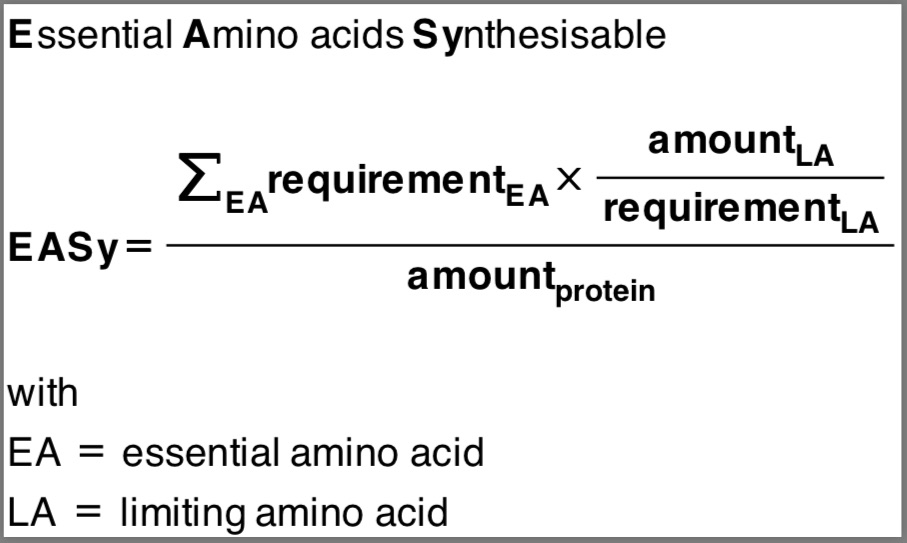
6. Calculate EASy
We are looking for a formula that maps the biological value of proteins for dogs in the maintenance metabolism, which can be built into a simple database query and provides reliable comparability. The thinking model I have developed determines the proportion of Essential Amino acids in the protein that can be used without detours for protein Synthesis. I briefly call the calculated key figure EASy.
Here finally the derivation of the formula:
6.1. Step 1: Efficiency of the Limiting Amino Acid (LA)
Which of the limiting amino acids and how high their coverage or efficiency for the body’s protein synthesis in a protein is, can be read from the amount of the lowest percentage of demand coverage (red labeled) in the amino acid profile:
For example, while the sum of methionine and cysteine in chicken breast meat limits the protein synthesis to 97% of these two amino acids, it is, for example in horse meat, tryptophan with only 58% coverage. Purely visually, this is easily recognizable in the graphic (red lettering) – calculated as follows:
The reported numbers correspond to the dog’s requirement for the respective amino acid in the maintenance metabolism in per kg of metabolic weight according to FEDIAF and the 3letter codes to the content of the amino acid in the examined protein. We calculate here in mg. Alternatively, the requirements according to NRC can also be used.
6.2. Step 2: Amount of synthesizable essential amino acids (EA)
To evaluate the amino acid pattern, we are interested in the amount of amino acids that can be used for protein synthesis. Based on the graphical representation, we cut off the „supernatants“ and count for each amino acid only the limited amount (red):
Computationally, the limiting ratio of the limiting amino acid (LA) determined above is multiplied by the total requirement of essential amino acids (EA) to obtain the amount of directly usable amino acids:
Here, too, the reported numbers correspond to the dog’s requirement for the respective amino acid in the maintenance metabolism per kg of metabolic weight according to FEDIAF . Alternatively, the requirements according to NRC can also be used. We calculate here in mg.
6.3. Step 3: Reference frame for relative evaluation of the synthesizable amount of amino acids (protein)
Now proteins are not only made up of essential amino acids but also of nonessential ones. The body could produce this with sufficient supply of essential ones and continue processing. This is apparently possible in the organism with less effort than by splitting, transporting, rebuilding and dismantling. Thus, even with a relatively low level of cover of the limiting amino acid, a protein may be relatively high in quality, unless in addition to the excesses of the essential, even larger amounts of nonessential amino acids are to be metabolized.
Thus, to make our calculated amount of synthesizable amino acids of the food, the weekly or daily ration comparable to other foods, weekly or daily rations, the total amount of protein is a suitable reference and ours
7. Practical application of the formula
With Hannes his food calculator you can create a corresponding prescription for your dog for the visual inspection of food and compare it so easily. The presentation is not „pretty“, but manageable.
7.1. Validate protein curve
First, examine the foods contained in the protein curve shown at the beginning. They climbed there like this:
1. Egg – 2. Salmon – 3. Chicken – 4. Lamb – 5. Beef – 6. Pig – 7. Soya flour – 8. Wheat.
| 100g food | kj | Prot | fat | KH | fiber | ash |
|---|---|---|---|---|---|---|
| Chicken, egg | 572 | 12 | 9 | 2 | 0 | 1 |
| Chicken, whole, without bone | 694 | 20 | 10 | 0 | 0 | 1 |
| Salmon frozen | 753 | 20 | 11 | 0 | 0 | 1 |
| Beef, meat 18% fat | 962 | 18 | 18 | 0 | 0 | 1 |
| Lamb, meat 16% fat | 903 | 19 | 16 | 0 | 0 | 1 |
| Soybean flour debittered, degreased | 1168 | 47 | 1 | 8 | 25 | 6 |
| Wheat, grain | 1382 | 11 | 2 | 60 | 13 | 2 |
| total | 6434 | 147 | 67 | 70 | 38 | 13 |
Food of the protein curve without pig as a recipe in Hannes his food processor
In Hannes his food calculator I leave pig, because dogs should eat no raw pig because of the Aujetzky danger (seems to be a german/european problem). The other ingredients are added in equal portions to a recipe. It can already be seen in tabular form that soybean meal (47%) is extremely high in protein, meat and fish have a mean protein content of just under 20%, while egg and wheat have low protein content.
Let’s take a look at the valence calculated using EASy: The proportion of synthesizable essential amino acids is displayed on the y-axis (the higher up, the more valuable) and in relation to the protein content on the x-axis (the further to the right, the richer Protein).
The chicken egg in this mixture has quite obviously with 36% the highest protein quality. In contrast to the above, soybean meal with only 23% of synthesizable protein is much worse ranked than wheat, whose protein quality at lower concentration equals at least 26% with the meat. The chicken has a higher protein quality at 30% than the terrestrial animals and is outperformed by salmon, which with an EASy-Wert value of 32% is closer to the chicken than to the egg.
In comparison to the above protein curve Hannes Sein Futterrechner comes to somewhat different results. Since I do not know how the protein curve was created, I can not assess what the true truth is.
7.2. Differentiate similar products
It can be quite enlightening to compare the different parts of an animal or product group with their individual components in terms of protein quality using EASy.
7.2.1. EASy of chicken ingredients
If you look at the chicken, the raw egg white (48%) has the absolute highest protein quality in my database, while the egg yolk is more likely to have chicken midfield. Among the meat and organ proteins, the thigh is the highest quality, the heart the weakest. Roughly in the midfield but with the highest protein content ranks the chicken breast.
7.2.2. EASy of beef parts
In the case of beef, the quality of the protein is inferior to that of the chicken in terms of synthesizable essential amino acids. Here, the liver has the highest quality, followed by the other organs, while stomachs (rumen and gizzard), throat and lung has a low quality of protein. This is consistent with the realization that stomach tissue (even in chicken) is very connective tissue rich and therefore inferior to muscle meat. However, I have often read under the label BARF the statement that the organs are very connective tissue rich and therefore contain inferior protein. I can not understand that directly. Surprisingly, the cattle skin before drying has a protein quality that corresponds to that of the meat.
7.2.3. A selection of seeds
Surprising is a consideration of various seeds compared to beef: oatmeal, spelled, sesame seeds and linseed are significantly higher than beef. Pumpkin seeds are very high in protein, rice is very low in protein.
In general, seeds are rich in minerals and vitamins, so that they seem to be suitable as dog food. Even if you assume only digestibility or availability of only 80%, you will still find high-quality protein here.
However, one must take into account that many plants protect their „embryos“ from premature germs by anti-nutritive substances such as phytates or the like. Thus, these „feed“ should be „defused“ by peeling, heating, watering, germination or fermentation before grinding. I have to read more about this topic in order to be able to assess this more precisely. In due course there will be a separate article.
7.3. Evaluate mixtures of different protein sources
Of course, the EASy parameter can not only be used to compare different foods based on 100g or so. By adding the amino acids and the total protein amount, each weighted with different product amounts, we can evaluate both „design protein“ and a feed plan or the daily ration.
Start with the assumption that the seeds from the previous example were each fed with 10g and supplemented with 100g of rice and 200g of beef. All in all, this would mean a mixture of energy, protein and fat for my Hannes that was just as good as demand – with regard to minerals, vitamins and fatty acids, this is not a balanced feed idea.
Various raw seeds in small quantities plus 100g rice and 200g beef:
| foods | g / day | kJ | Prot | fat | KH | fiber | ash |
|---|---|---|---|---|---|---|---|
| amaranth | 10 | 169 | 1 | 1 | 7 | 1 | 0 |
| buckwheat | 10 | 147 | 1 | 0 | 7 | 0 | 0 |
| cashew | 10 | 250 | 2 | 5 | 2 | 0 | 0 |
| spelt | 10 | 146 | 2 | 0 | 6 | 1 | 0 |
| oatmeal | 10 | 156 | 1 | 1 | 6 | 1 | 0 |
| millet | 10 | 149 | 1 | 0 | 6 | 1 | 0 |
| pumpkinseed | 10 | 243 | 4 | 5 | 0 | 1 | 0 |
| linseed | 10 | 204 | 2 | 4 | 1 | 2 | 0 |
| rice | 100 | 1486 | 7 | 1 | 78 | 2 | 1 |
| beef 18% fat | 200 | 1301 | 39 | 17 | 0 | 0 | 2 |
| sesame | 10 | 248 | 2 | 5 | 1 | 1 | 1 |
| sunflower seed | 10 | 205 | 3 | 3 | 3 | 1 | 0 |
| walnuts | 10 | 303 | 2 | 7 | 1 | 0 | 0 |
| wheat, germ | 10 | 157 | 3 | 1 | 3 | 2 | 0 |
| wheat, grain | 10 | 138 | 1 | 0 | 6 | 1 | 0 |
| total | 430 | 5302 | 71 | 50 | 127 | 14 | 4 |
| requirement | 5255 | 63 | 19 | ||||
| deviation | 47 | 8 | 31 |
All components supply different amounts of the respective amino acids, which, when summed up, are almost on demand. From the amino acid profile of the mixture, an EASy-Wert value of 25.85 can be calculated, which is slightly above the EASy-Wert of muscle meat alone:
Earlier, we dealt with the „protein design“ of potatoes and whole egg. In a 65:35 mixture of the egg and potato components – ie NOT the mixture of proteins considered separately above – the following picture emerges:
| foods | g / day | kJ | Prot | fat | KH | fiber | ash |
|---|---|---|---|---|---|---|---|
| Chicken, egg | 350 | 2003 | 41 | 33 | 5 | 0 | 3 |
| Cooked potatoes peeled | 650 | 1979 | 12 | 0 | 98 | 8 | 6 |
| total | 1000 | 3982 | 53 | 33 | 103 | 8 | 9 |
It can be clearly seen how protein contents per se, their quality and the proportions of the protein sources work together. The protein content of the potatoes in the amount of 2% with a value of 20% is sufficient at 65% mixing proportion to reduce the valence of the egg from 36% to a good 32%. From a potato point of view, on the other hand, the protein quality gets a tremendous boost from 20% to 32% – but in total there is no quality higher for the dog than the raw egg alone has to offer.
8. Critical consideration of the EASy formula
The formula is database applicable, comes with no complicated assumptions, trials and limitations, and allows without guidance the selection of protein sources for dogs, not just kidney patients.
The normal dog owner will hopefully not come into the embarrassment of having to calculate it himself and hopefully in such cases, a competent veterinarian or nutritionist at his side, who can solve the feeding problem if necessary for him.
With questions of the digestibility, the bioavailability, what exactly happens in the dog body with the supposed surpluses and what that means for the organs, I have to deal even more in detail. Nevertheless, I consider the formula applicable to largely unprocessed foods, in particular of animal origin and their approximate nutritional content, which can be looked up in nutritional databases.
For vegetable protein supplements there are various limitations of the actual usability (phytic acids, fibrous substances, oxalates, …?), With which I also have to deal more closely at first.
Maybe I’ve synthesized unhealthy semi-knowledge into outrageous nonsense here.
Maybe I also reinvented the wheel.
Is there anyone here who could give an informed opinion with justification?
Rework Note
This article is a recalculation of my eponymous article in Facebook . Due to a changeover of the data source in the meantime now slightly different results come out. This does not change the way of calculation.
Dieser Artikel wurde veröffentlicht: 30. Mai 2018 23:26comments